Last time we spoke about the nature of תשובה, and the difference between תשובה מיראה and תשובה מאהבה: do I reject the sinner I was or do I accept who I was and grow from there? The answer of course is, Yes. There is no absolute answer; both aspects of תשובה are applicable. Shlomo (in my reading) is now going to expand that idea.
ז ברצות ה׳ דרכי איש; גם אויביו ישלם אתו׃ ח טוב מעט בצדקה מרב תבואות בלא משפט׃ ט לב אדם יחשב דרכו; וה׳ יכין צעדו׃
On the surface, אויביו ישלם אתו is a statement about human beings and their opponents. If I do תשובה, then people will like me. Even those whom I offended.
והמקרא הזה יתכן שנסמך לעליון כי בעל התשובה אשר הרע לפנים לרבים בהכלמות ובצער ובגאוה ובוז, ולא יתכפר האדם בדברים שבינו לחברו בחסד ואמת עד שירצה את חברו. הנה ברצות את דרך תשובתו יתן בלבכם שיתרצו לו ונמצאו נזקיו כלא היו.
And the next psukim are not directly connected. They’re just good advice.
טוב מעט בצדקה מרב תבואות בלא משפט: הוא עצמו מה שכתוב בתהלות לז[:טז] טוֹב מְעַט לַצַּדִּיק מֵהֲמוֹן רְשָׁעִים רַבִּים. שמפרש הטעם כי (תהלים לז:יז) כִּי זְרוֹעוֹת רְשָׁעִים תִּשָּׁבַרְנָה וְסוֹמֵךְ צַדִּיקִים ה׳; שמעט של הצדיק הוא מוסמך מה׳, והרב של הרשע ההשגחה עוסקת להשחיתו, וכן הוא בממון וקנינים שלו, המעט שהשיג בצדקה הוא תחת השגחת ה׳ ויש לו קיום, ורב תבואות שהשיג בלא משפט ה׳ יאבידהו.
לב אדם יחשב: ר״ל שחושב עצות בלתי ראויות על דרכו, דע שלא יועיל, אחר שה׳ יכין צעדו, ולא יוכל לצעוד בלא רצון ה׳.
דער מענטש טראַכט און גאָט לאַכט.
These don’t seem to be connected. But the Midrash interprets אויביו ישלם אתו metaphorically.
ברצות ה׳ דרכי איש גם אויביו ישלם אתו:…רבי יהושע בן לוי אמר: זה יצר הרע, בנהג שבעולם אדם גדל עם חברו שתים שלש שנים בכרך והוא קושר לו אהבה, וזה גדל עם אדם מנערותו עד זקנותו, אם מצא בתוך שבעים הוא מפילו, בתוך שמונים הוא מפילו, הוא שדוד אומר (תהלים לה:י): כָּל עַצְמוֹתַי תֹּאמַרְנָה ה׳ מִי כָמוֹךָ; מַצִּיל עָנִי מֵחָזָק מִמֶּנּוּ וְעָנִי וְאֶבְיוֹן מִגֹּזְלוֹ. אמר רבי אחא: וכי יש גזלן גדול מזה, ואמר שלמה (משלי כה:כא): אִם רָעֵב שֹׂנַאֲךָ הַאֲכִלֵהוּ לָחֶם וְאִם צָמֵא הַשְׁקֵהוּ מָיִם: מלחמה של תורה, היך מה דאת אמר (משלי ט:ה): לְכוּ לַחֲמוּ בְלַחֲמִי; ומימה של תורה, היך מה דאת אמר (ישעיה נה:א): הוֹי כָּל צָמֵא לְכוּ לַמַּיִם.
The enemies here is the יצר הרע, our inborn inclination to do evil. Malbim puts both interpretations together: if we act רצות ה׳, then our natural inclincation will at peace with our conscience, and ה׳ will give us peace from our enemies.
ואז ישלים ה׳ אויביו אתו, שהם אויביו הפנימים שהם ציורי התאוות שיהיו שלמים אתו אחרי שלא יעלה בלבו ציור רע כלל שזה גדר התמימות, וע״י שישלמו אויביו הפנימים ישלים ה׳ אתו גם אויביו החיצונים, מדה כנגד מדה, כשם שהוא השלים עם ה׳ אויבי הנפש האלקית.
Note that אויביו is plural. We don’t have just one יצר הרע, and I want to talk about that. I’ve discussed many times before about my model for what יצר הרע means, and I ask your indulgence as I try to put it together coherently in one long essay.
These thoughts largely come from Maharal, as understood by Rav Moshe Shapiro and presented by Rabbi Jeremy Kagan in The Jewish Self and The Choice to Be.
But my essential argument is that the יצר הרע is not a Jewish concept or even a religious one. It comes from a purely scientific view of human behavior (as we will see, the ראשונים all cite Greek authorities when discussing it). So I’m going to quote liberally from the ur-athiest, Richard Dawkins.
We start with an apparently anodyne fact: life is different from non-life.
At some point a particularly remarkable molecule was formed by accident…It may not have necessarily been the biggest or most complex molecule around, but it had the extraordinary property of being able to create copies of itself…[S]uddenly, a new kind of “stability” came into the world. Previously it is probable that no particular kind of complex molecule was very abundant in the soup [the mix of chemicals in the water in ancient Earth], because each was dependent on building blocks happening to fall by luck into a particular stable configuration. As soon as the replicator was born it must have spread it copies rapidly throughout the seas, until the smaller building block molecules became a scarce resource, and other larger molecules were formed more and more rarely.
We could look at the world as a bunch of interacting chemicals, but the complexity of the interactions between those chemicals makes this new distinction useful. Life is “active”, taking resources from the environment for its own replication. There is no sharp line between life and nonlife.
The boundaries which divide Life from Death are at best shadowy and vague. Who shall say where the one ends, and where the other begins?
Are viruses alive? Is a bare strand of DNA? Depends on how you want to define the words. There is not absolute answer. But the distinction is still useful in understanding the world.
So we have things that are alive, and that create copies of themselves, so there are more of them. But the copying isn’t perfect and some versions last longer or make more copies than others, and life evolves. And eventually some of those copies are able interact with other chemical-mixtures in real time. We call those “animals”.
Animals became active go-getting gene vehicles: gene machines. The characteristic of behavior…is that it is fast…Animals…have evolved ways of moving hundreds of thousands times faster. Moreover, the movements they make are reversible, and repeatable an indefinite number of times…[B]rains [act] by controlling and coordinating the contractions of muscles.
So we have a new level of complexity; animals are alive but also have what we would call behavior.
A creature has to move if it is to interact with other creatures. Muscles, neurons and brains are good for staying alive in a competitive environment, but it would be even better to be proactive, to predict the consequences of behavior to optimize the outcome. Brains become prediction machines, and we have another level of complexity.
One of the most interesting methods of predicting the future is simulation…It is better to try the various plans out in dummy runs than in deadly earnest.
We now have intelligence (or more precisely, sapience). Dawkins uses the word “simulation”. I use the word “model”. Brains contain models of the outside world to predict the future. Brains can even develop ways of putting those models into other brains; they can “communicate”.
So we have a four-fold model of ever-increasing complexity, each level an epiphenomenon of the lower one.
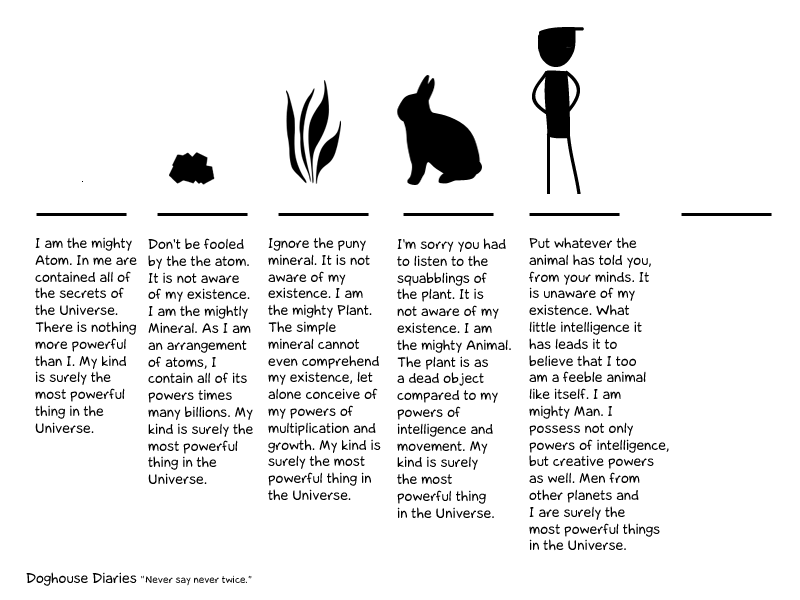
(note the blank panel on the right; we’ll get to that).
Again, I use The Selfish Gene here because I want to emphasize that this model is not a religious or even mystical model; it’s very much in line with a hard atheist view like Dawkins’s. But that model exists in Jewish thought as well:
דומם צומח חי מדבר: (ר״ת: דצח״מ) הם ארבע דרגות כלליות בנבראים. שכללות הנבראים בעולמות מתחלקים לארבע דרגות אלו, הן בנבראים הגשמיים, והן ברוחניות.
Each level is a subset of the previous one; plants are chemical agglomerates; animals have all the chemical homeostatic mechanisms that plants do; and human beings have animal behaviors.
It’s also worth noting that this hierarchy is anthropocentric; if we were plants, we would probably put photosynthesis as the highest value. But that’s fine, since I don’t care about minerals, plants or animals. I care about people and their behavior. And we can look at people as having all these levels, what חב״דפדיה called the דרגות in רוחניות. We’re going to ignore the דומם, since I can’t directly control my internal chemical processes. We like to divide the workings of our inner selves into these three classes.
דע שנפש האדם אחת. ויש לה פעולות רבות חלוקות, יקראו קצת הפעולות ההם נפשות, ויחשב בעבור זה שיש לאדם נפשות רבות, כמו שחשבו הרופאים. עד ששם ראש הרופאים פתיחת ספרו שהנפשות שלושה: טבעית, וחיונית, ונפשית.
ופעמים שיקראו כוחות וחלקים, עד שיאמר חלקי הנפש, ואלו השמות יעשו הפילוסופים הרבה פעמים. ואינם רוצים באמרם חלקים שהיא מתחלקת כהחלק הגופות, אבל הם מונים פעולותיה החלוקות שהם כלל הנפש, נחלקים בחלקים לכל המחובר מהחלקים ההם.
אמר אברהם המחבר: יש חכמים גדולים, חכמי השתי תורות ולא התעסקו בחכמת התולדות על כן לא יכולתי לפרש אלה הברכות, אם לא אזכיר מעט מן החכמות. בעבור שגוף האדם מהעולם השפל, והנשמה העליונה קשורה בו, ויש אמצעיים בין הנשמה והגוף. והנה הם שני כחות, ובלשון הקדש יקראו על הרוב רוח ונפש. כי הנשמה היא החכמה, ומושבה במוח הראש…והרוח בלב ובו חיי האדם, והיא המבקשת שררה להתגבר על כל העומד כנגדה והיא בעלת הכעס…והנפש בכבד, והיא המתאוה לאכול, וככה כתוב (דברים יב:כ) כִּי תְאַוֶּה נַפְשְׁךָ; ותאות המשגל ממנה. והנה יש אדם שנברא שתהיינה לו אלו השלש הנזכרות חזקות, או כלן רפות, או זו חזקה וזו רפה, או לא חזקה ולא רפה, והנה בני אדם על כ״ז מינים משונים.
The מעט מן החכמות comes from Plato.
In Republic Book IV, Plato delineates the human soul [ψῡχή] as comprising three distinct parts: the logistikon [λογιστικόν](rational part), which seeks truth, wisdom, and calculation; the thumoeides [θυμοειδές] (spirited part), which provides motivation, courage, and adherence to honor; and the epithumetikon [ἐπιθυμητικόν] (appetitive part), which pursues bodily desires such as hunger, thirst, and sensual pleasures.
The appetitive soul corresponds to the צומח; the spirited soul corresponds to the חי; and the rational soul corresponds to מדבר. Soul here isn’t really what we call the spiritual soul; it’s an abstraction of all the things that make us alive and not dead. Call it נפש חיה, in the terms of בראשית, or psyche, in Plato’s terms. The problem is that we have so many things to define and not enough words to use, and different people use each word differently.

But these terms are familiar; we’ve heard the terms נפש-רוח-נשמה or נר״ן many times.
As we’ve said many times, The Categories Were Made For Man, Not Man For The Categories. The human psyche is unitary; we make categories that are useful for our understanding, for forming our models of the world. We could make other categorizations; often we will combine both of Ibn Ezra’s אמצעיים בין הנשמה והגוף into נפש בהמית and call נשמה the נפש אלוקית.
We haven’t gotten to the יצר הרע yet, but we’re close. Both Plato and Ibn Ezra emphasize that these “parts” are what motivate behaviors: “seeks”, “provides motivation”, “pursues”, “מבקשת”, ”מתאוה“. The psyche is what motivates behavior. And the underlying motivation for all our behavior is survival.
Darwin’s “survival of the fittest” is really a special case of a more general law of survival of the stable. The universe is populated by stable things. A stable thing is a collection of atoms which is permanent enough or common enough to deserve a name. It may be a unique collection of atoms, such as the Matterhorn, which lasts long enough to be worth naming. Or it may be a class of entities, such as raindrops, which come into existence at a sufficiently high rate to deserve a collective name, even if any one of them is short-lived.
To the extent that our behaviors are determined by our genes, those behaviors must maximize our “stability”—staying alive and having progeny. If not, those genes would not propagate. In terms of our model, we have needs at every level of the model and we act to satisfy those needs. It’s like Maslow’s pyramid.
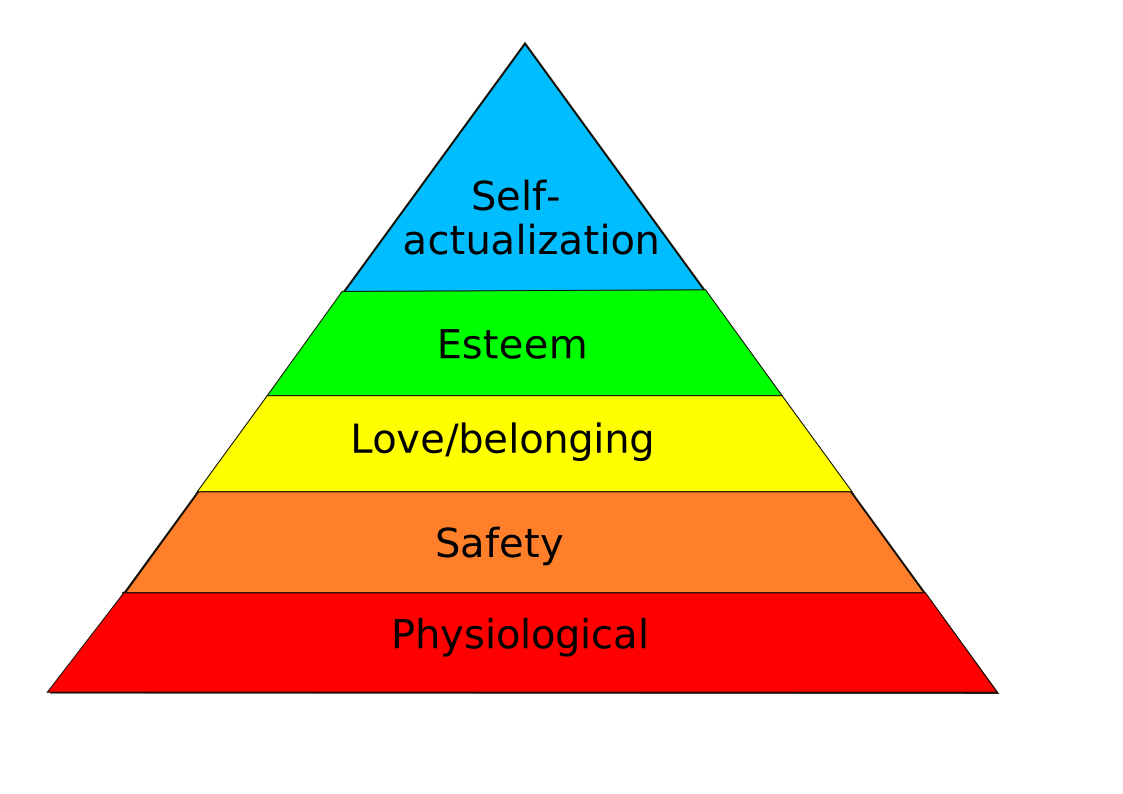
The model here has a different hierarchy, but the idea is the same. We have צומח needs and חי needs and מדבר needs, and we say that the נפש is that part of our psyche that controls behaviors that meet צומח needs, the רוח controls חי needs, and the נשמה controls מדבר needs.
So what is it that we call the יצר הרע?
יצר means “inherent nature”, the way we are created, in our genes as influenced by our environment. רע in this sense is not a moral judgment but a statement that our behavior is aimed at meeting our own needs rather than ה׳'s purpose in creation.
Literally, the word רע, which is translated as “evil”, means “broken off” ((תהילים ב:ט) תְּרֹעֵם בְּשֵׁבֶט בַּרְזֶל—Break them with an iron rod), meaning broken off from the Creator.
It’s also being broken off from one another, being self-centered. It’s natural.
וירח ה׳ את ריח הניחח ויאמר ה׳ אל לבו לא אסף לקלל עוד את האדמה בעבור האדם כי יצר לב האדם רע מנעריו; ולא אסף עוד להכות את כל חי כאשר עשיתי׃
And it’s interesting that the mishna describes three aspects of the יצר הרע.
רבי אלעזר הקפר אומר: הקנאה והתאוה והכבוד, מוציאין את האדם מן העולם.
We’ve translated קנאה as mimetic desire; as a social primate, I take my cues from those around me, and I want what others want. תאוה is usually translated as “lust” but it really means “appetite”, the desire to fulfill my physical needs. And we’ve translated כבוד not as “honor”, which doesn’t have much meaning in 21st century America, but as “status”: where do I rank relative to those around me? What do other people think of me?
People are social creatures who thrive on connection and approval. Social validation activates the brain’s reward system, releasing dopamine, which creates a feeling of pleasure. This neurological response makes validation-seeking behaviour highly reinforcing.
Maharal connects these three aspects of יצר הרע to the three parts of the psyche.
דע לך כי האדם שהוא בעל חי, יש לו נפש. והנפש הזאת יש לה כחות מחולקות, שפועלת באלו כוחות פעולות מחולקות…וכתב הרמב״ם ז״ל בהקדמת מסכתא הזאת [פרקי אבות] שֶׁשָׂם ראש הרופאים התחלת ספרו שהנפשות שלש; טבעית, חיונית, נפשית…והוא ז״ל כתב שאין הדבר כך שיהיה לאדם ג׳ נפשות, אבל הנפש היא אחת, רק שיש לה כחות מחולקות, שפעולתה בכחות ההם פעולות מחולקות…
ובאר ענין ג׳ כחות אלו; כח טבעי, הוא הכח שמקבל ההזנה שהאדם ניזון, ודוחה למותרות הטבע, ומגדל את הגוף באורך וברוחב כאשר הוא. ומכח זה בא התאוה לזנות, שהוא על ידי מותרי הטבע שמבשל כח זה, וכל כח התאוה הוא מכח זה שנקרא כח טבעי, ומשכן כח הזה הוא בכבד. הכח השני הוא כח החיוני, שממנו החיות, ועל ידי כח זה האדם הוא מתנועע ממקום למקום, וממנו מתחדש הנקימה והנטירה והקנאה והשנאה, ומשכן הכח הזה הוא בלב, ששם הכח הזה. הג׳ הוא כח נפשי, הכח הזה יבאו ממנו כוחות הרבה, כמו כוחות החושים החמשה, וכח המחשבה והדמיון והזכרון והשכל, ומשכן כח זה במוח. סוף סוף יש חלוק כחות לנפש.
[rearranged for clarity] והכבוד הוא לכח השכלי, אשר כח זה השכלי הוא מבקש הכבוד…וכדכתיב (משלי ג:לה) כָּבוֹד חֲכָמִים יִנְחָלוּ…ועוד כתיב (ויקרא יט:לב) מִפְּנֵי שֵׂיבָה תָּקוּם וְהָדַרְתָּ פְּנֵי זָקֵן, (קידושין לב,ב) ואין זקן אלא זה שקנה חכמה…וכאשר הוא יוצא מן השעור ברדיפת הכבוד יותר מן הראוי, הרי מגיע לו חסרון והעדר מצד הכח הזה.
…וחכמינו ז״ל יקראו אותם (בראשית רבה יד:ט) רוח נפש ונשמה, וכך ראוי לקרות אותם.
ולפי חלוק אלו שלשה כחות אמרו ”הקנאה והתאוה והכבוד מוציאין את האדם מן העולם“. כי אחר שהנפש יש לה אלו ג׳ כחות אשר בארנו למעלה, אם יצא מן השעור באלו ג׳ כחות, הרי יוצא מן העולם. שהאדם הוא בעולם על ידי אלו ג׳ כחות, כי האדם בעולם על ידי כח נפשי, אם הוא יוצא על ידי כח זה מן השעור, הוא נוטה אל ההעדר…
כלל הדבר: כי על ידי אלו ג׳ דברים הנפש של האדם יוצא מגבול שלו אשר ראוי לנפש. ולכך אמר לשון ”מוציאין אותו מן העולם“, כלומר מפני שהוא יוצא באלו שלשה דברים מן הגבול אשר ראוי לנפש, לכך יש לאדם יציאה בהן מן העולם, וכבר מבואר הוא.
To summarize:
| חלק מנפש חיה | שם בקבלה | Greek | English | יצר הרע |
|---|---|---|---|---|
| צומח | נפש | ἐπιθυμητικόν | Vegetative | תאוה |
| חי | רוח | θυμοειδές | Vital | קנאה |
| מדבר | נשמה | λογιστικόν | Intellectual | כבוד |
The needs expressed by each of these levels of the psyche are real and must be met. It’s when they are excessive, יוצא מגבול שלו אשר ראוי לנפש, that they are destructive. When Shlomo says ברצות ה׳ דרכי איש; גם אויביו ישלם אתו the Midrash is telling us that אויביו are these various aspects of the יצר הרע. We have the urge to meet our own needs, but these urges are not our friends. We have to act in a way that is consistent with רצון ה׳, and then we can live in peace with those urges. They will not control us.
But that is not the whole story.
Where do these names, נפש-רוח-נשמה, come from?
חמשה שמות נקראו לה: נפש, רוח, נשמה, יחידה, חיה.
These all come from תנ״ך.
וייצר ה׳ אלקים את האדם עפר מן האדמה ויפח באפיו נשמת חיים; ויהי האדם לנפש חיה׃
מי יודע רוח בני האדם העלה היא למעלה; ורוח הבהמה הירדת היא למטה לארץ׃
הצילה מחרב נפשי; מיד כלב יחידתי׃
כי רדף אויב נפשי דכא לארץ חיתי; הושבני במחשכים כמתי עולם׃
In the context of the Midrash, these are all presented as synonyms. תנ״ך doesn’t have these elaborate taxonomies of spiritual ideas. It’s only later, with the exposure of Jewish thought to Babylonian and especially Greek thought, that we had to give names to these things, to reify holistic concepts into categories.
רבי שמעון בן לקיש אמר: אף שמות המלאכים עלו בידן מבבל.
The later Kabbalists and philosophers, looking at the Greek classification of the psyche, used the first three terms for the tri-partite soul as we said before. The last two names, יחידה and חיה, are poetic names that are found only in תהילים, and aren’t used in the most common taxonomy.
But those other two terms are there, and the Kabbalists used them as a way to subdivide the נשמה, looking at the שכל (what we previously called נשמה) as composed of נשמה and חיה and יחידה (in that order).
To understand that, it’s worth looking closer at human intelligence, which we defined as the ability to form internal models to predict the future. A sophisticated model should include modeling other people’s internal models. I have to realize that you are also thinking. I need a Theory of Mind.
Theory of mind denotes the cognitive ability to represent and infer mental states—such as beliefs, desires, intentions, knowledge, and emotions—in oneself and others, recognizing that these states can differ from one’s own and drive observable behavior.
But if I have an internal model of your internal model, I can also have an internal model of my own internal model. I can be “self-aware”.
[T]he brain’s simulation of the world becomes so complete that it must include a model of itself. Obviously the limbs and body of a survival machine must constitute an important part of its simulated world; presumably for the same reason, the simulation itself could be regarded as part of the world to be simulated…Another word for this might indeed be “self-awareness”…[I]t involves an infinite regress—if there is a model of the model, why not a model of the model of the model…?
This question—how can a model include itself—is at the core of the question of whether a computer can be self-aware (see Douglas Hofstadter and Daniel Dennett’s The Mind’s I), but human beings are certainly self-aware.
This is different from what we’ve called “consciousness”, which we discussed in Of Cabbages and Kings.
Consciousness, in the sense used here, is the existence of an inner life: the thoughts, sensations, and feelings that constitute ‘what it is like’ to be a system acting in the world. For many, the motivation to study consciousness is encapsulated in David Chalmers’ observation that “There is nothing that we know more intimately than conscious experience, but there is nothing that is harder to explain”.
We connected consciousness to the צלם אלוקים and to human free will:
נעשה אדם בצלמנו: הצלם האלוקי הוא הבחירה, בלי טבע מכריח, רק מרצון ושכל חפשי…אנו יודעים שהבחירה החופשית הוא מצמצום האלוקות, שהשי״ת מניח מקום לברואיו לעשות כפי מה שיבחרו.
What we call free choice is really a specific capacity given to man through which he actualizes self. Instances of moral choice provide the context in which this capacity can be active. The capability to freely choose is the loftiest element of creation, allowing man—uniquely among all other creations—to achieve being.
Where does our individuality and selfhood really lie? When am I an “I”? In what act do I genuinely actualize myself?…
The answer is, we are a self and achieve our unique individuality in our moments of choosing. We pass most of our time carried by the currents that intersect our lives—pulled along by the awakening of this emotion or that inclination. We function as passive nodes through which forces external to our essential self flow…The only time we actually exist in our unique individuality is when we stand above the play of various forces and pulls, making a genuine decision.
That is consciousness, the sense of being. That is outside our model. The self-awareness here is purely intellectual, an epiphenomenon of having a brain. It means that my mental model of the world includes the fact that I have a mental model. I can think about my own thinking. It is part of our יצר and is as mechanical and deterministic as the rest of our bodies.
As Aquinas said:
Anima mea non est ego.
I am not my anima [usually translated as “soul”, bur we are calling “psyche”].
In terms of Jewish philosophy, this fourth aspect of psyche appears in the Maharal when he discusses the four beasts that Daniel saw. They represented four different kingdoms, and Marahal says that each of them represent a different part of the psyche, and that there is a level that integrates all of the previous three. We had נפש-רוח-נשמה and now we have something new.
ועוד ראה דניאל חיה רביעית, (דניאל ז:ז) וְהִיא מְשַׁנְּיָה מִן כׇּל חֵיוָתָא. וכבר אמרנו, כי דבר זה נגד מה שהאדם כלול מן אלו ג׳ דברים, שהם; כח גופני שיש באדם, ויש כח נפשי, ויש לאדם כח שכלי…אבל יש באדם כח משותף לכל אלו ג׳ חלקים ביחד, ואין כאן מקום זה לבאר, כי כך הם דברי חכמים בכל מקום, ובארנו זה בכמה מקומות.
The Kabbalists use the term חיה for this level of the psyche: the knowledge that I exist, I have חייות. And the יצר הרע that corresponds to this is solipsism: I am the only thing that really exists. It leads to arrogance.
ויש דעות שאסור לו לאדם לנהג בהן בבינונית אלא יתרחק מן הקצה האחד עד הקצה האחר. והוא גבה לב, שאין דרך הטובה שיהיה אדם עניו בלבד אלא שיהיה שפל רוח ותהיה רוחו נמוכה למאד. ולפיכך נאמר במשה רבנו (במדבר יב:ג) עָנָו מְאֹד ולא נאמר ענו בלבד. ולפיכך צוו חכמים (משנה אבות ד:ד) מאד מאד הוי שפל רוח. ועוד אמרו (סוטה ד,ב) שכל המגביה לבו כפר בעקר שנאמר (דברים ח:יד) וְרָם לְבָבֶךָ וְשָׁכַחְתָּ אֶת ה׳ אֱלֹקֶיךָ.
Maharal adds that this is also the יצר הרע for nihilism and wanton destructiveness.
אמנם מלכות הרביעית, מפני שרואה עצמה שהיא כל ואין זולתו, ולכך היא רוצה שלא יהיה נמצא אחר, ולכך הוא משחית הכל, ואין זה רק השחתה. ולכך ראה דניאל את החיה הזאת שיש לה שנים של ברזל, כי הברזל הוא משחית ומקצץ את הכל, וכמו שבארנו במקומו, שכל ענין מלכות זה רק להשחית.
It’s the inherent urge that Freud didn’t call thanatos, but his students did.
Freud’s death instinct concept, also known as “Thanatos,” suggests that humans possess an innate drive towards self-destruction and aggression. The death instinct represents a fundamental aspect of the human psyche, aiming for an eventual return to an inorganic state.
And again, the יצר הרע for גאווה is not inherently a bad thing; it just needs to be channeled appropriately.
Yet there is no getting away from our own vantage point…It’s hardwired into the fabric of creation…The anav…too says, “The world was created for me”, because this is engrained within all of us, yet his statement has a spin. He is actually saying, “The world was created for me to give”.
And the fifth level, יחידה? If I can have a mental model that includes itself, then I can expand that mental model to include the Infinite. I can, theoretically, have a mental model of G-d. This is an explicitly religious idea, so it’s hard to find a secular source that expresses it (though it comes close to the yoga concept of being one with the universe).
Yechida…is the essence of the soul which is naturally and immutably bound to the Holy One. Rabbi Shimon bar Yochai declared, “Throughout the days of my connection to this world, I was bound to the Holy One Blessed Be He with a single knot…at one with Him”; this is the level of soul revealed at the moment of self-sacrifice or martyrdom for the sake of G‑d, His Torah, or His people.
The need expressed by the יחידה is the need to be close, to be connected to G-d. What יצר הרע could be associated with such a high spiritual level? What does is mean to be יוצא מגבול שלו אשר ראוי לנפש for this? There’s a fascinating gemara about the beginning of the second בית המקדש:
ויקם על מעלה הלוים ישוע ובני קדמיאל שבניה בני שרביה בני כנני; ויזעקו בקול גדול אל ה׳ אלקיהם׃
מאי אמור? אמר רב ואיתימא ר׳ יוחנן: בייא בייא! היינו האי [רש״י: יצר הרע של עבודת כוכבים] דאחרביה למקדשא וקליה להיכליה וקטלינהו לכולהו צדיקי ואגלינהו לישראל מארעהון, ועדיין מרקד בינן! כלום יהבתיה לן אלא לקבולי ביה אגרא. לא איהו בעינן ולא אגריה בעינן. נפל להו פיתקא מרקיעא דהוה כתב בה ”אמת“…אותיבו בתעניתא תלתא יומין ותלתא לילואתא. מסרוהו ניהליהו; נפק אתא כי גוריא דנורא מבית קדשי הקדשים. אמר להו נביא לישראל: היינו יצרא דעבודה זרה שנאמר (זכריה ה:ח) וַיֹּאמֶר זֹאת הָרִשְׁעָה וַיַּשְׁלֵךְ אֹתָהּ אֶל תּוֹךְ הָאֵיפָה; וַיַּשְׁלֵךְ אֶת אֶבֶן הָעוֹפֶרֶת אֶל פִּיהָ.
The חכמים of that time (named the אנשי כנסת הגדולה) destroyed the יצר הרע for עבודה זרה! But as they said, לא איהו בעינן ולא אגריה בעינן. There was a price to be paid.
א ביום ההוא יהיה מקור נפתח לבית דויד ולישבי ירושלם לחטאת ולנדה׃ ב והיה ביום ההוא נאם ה׳ צבא־ות אכרית את שמות העצבים מן הארץ ולא יזכרו עוד; וגם את הנביאים ואת רוח הטמאה אעביר מן הארץ׃
סדר עולם פרק ל:ב: עד כאן היו הנביאים. פירוש: משהרגו את היצר הרע בטלה הנבואה; עכ״ל הגר״א. וזהו יצרא דעבודה זרה כמבואר ביומא.
ולדעתי כוונתו אל דברי הפסוק זכריה (יג:ב) וְהָיָה בַיּוֹם הַהוּא נְאֻם ה׳ צְבָאוֹ־ת אַכְרִית אֶת שְׁמוֹת הָעֲצַבִּים מִן הָאָרֶץ וְלֹא יִזָּכְרוּ עוֹד; וְגַם אֶת הַנְּבִיאִים וְאֶת רוּחַ הַטֻּמְאָה אַעֲבִיר מִן הָאָרֶץ…ועל זה כיון הגר״א, ודו״ק, כי לזה כוונת הפסוק על נבואת אמת…וזה ענין רחב צריך ביאור במושכל, ואכמ״ל.
Before this, there was an incredibly powerful urge to worship עבודה זרה, to see everything in the world as a god.
רב אשי אוקי אשלשה מלכים. אמר למחר נפתח בחברין. אתא מנשה איתחזי ליה בחלמיה. אמר: חברך וחבירי דאבוך קרית לן? מהיכא בעית למישרא המוציא? אמר ליה: לא ידענא! א״ל: מהיכא דבעית למישרא המוציא לא גמירת וחברך קרית לן? א״ל: אגמריה לי ולמחר דרישנא ליה משמך בפירקא. א״ל: מהיכא דקרים בישולא.
א״ל: מאחר דחכימתו כולי האי מאי טעמא קא פלחיתו לעבודה זרה? א״ל: אי הות התם הות נקיטנא בשיפולי גלימא ורהטת אבתראי.
למחר אמר להו לרבנן: נפתח ברבוותא.
According to this understanding of the גר״א, it was the יחידה, the ability and the need of the human mind to feel a connection to the divine, that led to pantheism, seeing gods in every aspect of the universe. That was the יצר הרע for עבודה זרה. But it was also that connection that made prophecy, a real connection to the divine, possible.
…ראו אנשי כנסת הגדולה צורך להשתדל בכל כחותיהם הרוחניים לבטל מישראל את יצר הרע של עבודה זרה, שבו ראו סיבת החורבן. והיו מוכנים לוותר תמורת זה על השכר הגדול הכרוך במציאות יצר הזה וכיבושו. ומצינו בדברי ר׳ צדוק הכהן זצ״ל, שכל עוד שהיה קיים יצה״ר של עבודה זרה, היתה כנגדו הנבואה והיו נסים גלויים בישראל.
So what אנשי כנסת הגדולה was prayed for the human יחידה to be ennervated. We have no יצר הרע for עבודה זרה today, with the price that we have no great yearning to be close to הקב״ה. We are missing an important part of our psyche. I won’t decide whether it was worth it; it is the reality.
So to summarize, we look at human behavior and divide the internal motivation for those behaviors into five categories:
| חלק מנפש חיה | שם בקבלה | English | יצר הרע |
|---|---|---|---|
| צמח | נפש | Vegetative | תאווה |
| חי | רוח | Vital | קנאה |
| מדבר | נשמה | Intellectual | כבוד |
| חיה | Self-Aware | גאווה | |
| יחידה | Transcendent | עבודה זרה |
So now, back to ספר משלי. How do we read ברצות ה׳ דרכי איש; גם אויביו ישלם אתו?
We talk about loving ה׳ in the שמע:
ואהבת את ה׳ אלקיך בכל לבבך ובכל נפשך ובכל מאדך׃
לבבך has two ב's where לב has only one; it should be לִבֶּיךָ. לבב has the subtler meaning, that “לב”—mind—has two aspects.
בכל לבבך: בשני יצריך, ביצר טוב וביצר הרע.
דרש רב נחמן בר רב חסדא: מאי דכתיב (בראשית ב:ז) וַיִּיצֶר ה׳ אֱלֹקִים אֶת הָאָדָם, בשני יודין? שני יצרים ברא הקדוש ברוך הוא, אחד יצר טוב ואחד יצר רע.
We are created (in Dawkins’s terms, our genes determine our behavior) with two competing urges: the urge to meet our own needs (the יצר רע) and the urge to fulfill רצון ה׳ (the יצר טוב, though of course Dawkins wouldn’t acknowledge that).
The יצר טוב is other-directed. Just as we said that רע in “יצר הרע” means “broken off”, טוב in יצר הטוב means “connected to a higher purpose”. Rav Hirsch makes this point on the expression שכל טוב.
וידבר יחזקיהו על לב כל הלוים המשכילים שכל טוב לה׳; ויאכלו את המועד שבעת הימים מזבחים זבחי שלמים ומתודים לה׳ אלקי אבותיהם׃
ראשית חכמה יראת ה׳ שכל טוב לכל עשיהם; תהלתו עמדת לעד׃
שכל טוב would denote the higher spirit, emanating from G-d…For this spirit is in truth the one which is directed to “what is good” and which enables man to reach the highest “good” that is within his power to acquire.
וכשאני לעצמי, מה אני?
Human beings possess a native moral spirit, even without religious foundations. Conscience is etched into the heart: a sensitivity to suffering, an urge to relieve it, a basic instinct for fairness. These impulses stir within us even without the cadence of halacha; Hashem Himself engraved them into the human soul.
Even Richard Dawkins acknowledged the possibility of a יצר הטוב:
It is possible that yet another unique quality of man is a capacity for genuine, disinterested, true altruism…We have at least the mental equipment to foster our long-term selfish interests rather than merely our short-term selfish interests. We can see the long-term benefits of participating in a ‘conspiracy of doves’, and we can sit down together to discuss ways of making the conspiracy work. We have the power to defy the selfish genes of our birth and, if necessary, the selfish memes of our indoctrination. We can even discuss ways of deliberately cultivating and nurturing pure, disinterested altruism—something that has no place in nature, something that has never existed before in the whole history of the world. We are built as gene machines and cultured as meme machines, but we have the power to turn against our creators. We, alone on earth, can rebel against the tyranny of the selfish replicators.
And we’ve talked about the idea (in The Heart Knows) that this יצר הטוב engraved into our soul, is, in the Midrashic image, taught to us by an angel in the womb.
ומלמדין אותו [העובר] כל התורה כולה…וכיון שבא לאויר העולם, בא מלאך וסטרו על פיו, ומשכחו כל התורה כולה.
בשעה שהתינוק נוצר בבטן אמו כלולים בו יצר הטוב ויצר הרע. אך היצר הרע נמצא בו רק ב”כוֹח“ ולא בפועל (”נזר הקודש“ לר׳ יחיאל מיכל על בראשית רבה סג:ו ד״ה זורו רשעים מרחם) ואינו שולט בו (”ספר חסידים“ סימן תתשלז). ולעומתו היצר הטוב נמצא בו בפועל, ושׁורה עמו ממש בתוך בטן אמו (עפ״י ”מגדל עוז“ ליעב״ץ עליית יצר הטוב וד״ה ודע כי ענין יצר טוב, עפ״י ”מדבר קדמות“ להחיד״א מערכת י אות יד). באותו הזמן התינוק לומד את כל התורה (”מדבר קדמות“ מערכת י אות יד) שהם שבעים פנים שבה, על ידי היצר הטוב (עפ״י זוהר פרשת בא דף מא ע״ב ד״ה ”וקודם דייתי“ רעיא מהימנא)…
Rabbi Akiva Tatz (in his Chanukah CD) talks about this antenatal Torah. It’s not the literal words of the Torah; we certainly don’t know the Torah in the womb in that sense. The Torah we learn is this urge to serve ה׳ that is implanted in our minds, counterbalancing the self-oriented psyche. So it it clear what it means to love ה׳ with the יצר טוב. But how do we love ה׳ with the יצר רע?
One answer is that we love ה׳ by fighting the יצר רע.
ניתן לומר כי הכוונה ע׳'י השתדלות גדולה למגר את היצר הרע המסית ומדיח אותנו לעבור עבירות וכדומה.
That is certainly a valid way to look at the יצר רע. ה׳ created it to allow us to have free will, to be able to become something greater than we were before. If all we had was the יצר טוב that the angel gave us, we would be angels. And that’s not a good thing.
Human beings differ from angels in their ability to change, to grow and improve. Angels cannot change; they remain the same from the moment they come into existence until they expire. For this reason, the prophets generally describe angels as Omedim, “standing.” Angels stand in only one place, unable to advance or progress forward. Human beings, by contrast, are often referred to as Holechim, “walking,” referring to their capacity to progress, to move forward, to grow, to work on their characters and become better. If a person remains stagnant and complacent, if he has no interest in improving himself and advancing to the next level in religious observance and character refinement, then he has negated his most basic human quality.
But there is a higher way to love ה׳ with the יצר רע. It’s like the distinction we made between תשובה מיראה and תשובה מאהבה, but now with respect to our own sense of self-preservation: should I have אהבת היצר הרע or יראת היצר הרע? The answer, of course, is “yes”.
אך ניתן גם לומר כי ישנה לפעמים עבודת ה׳ בתכונות הרעות של האדם, כמו למשל במידות כמו נקמה, אכזריות, כעס וכדומה. אם מידות אלו מופעלות ומופנות להכניע את הרע והרשע, הרי שזהו ”שימוש חוקי ביצר הרע“.
The יצר רע is a gift from ה׳. Use it. The רע was created for a purpose, and thus is paradoxically טוב.
(בראשית א:לא) וְהִנֵּה טוֹב מְאֹד, זה יצר רע. וכי יצר הרע טוב מאד, אתמהא? אלא שאלולי יצר הרע לא בנה אדם בית, ולא נשא אשה, ולא הוליד, ולא נשא ונתן.
The gemara in יומא that we quoted above says that the אנשי כנסת הגדולה who eliminated the יצר רע for עבודה זרה tried to eliminate the יצר רע for תאוה and found that the world would not survive.
אמרו הואיל ועת רצון הוא נבעי רחמי איצרא דעבירה [תאוה]! בעו רחמי ואמסר בידייהו. אמר להו: חזו דאי קטליתו ליה לההוא כליא עלמא. חבשוהו תלתא יומי ובעו ביעתא בת יומא בכל ארץ ישראל ולא אשתכח.
ה׳ doesn’t want us to only listen to our יצר טוב. Hillel points out the flip side of כשאני לעצמי, מה אני:
אם אין אני לי, מי לי?
I can’t give everything of myself away, because then there would be no “me”.
אמר רבי אילעא, באושא התקינו: המבזבז, אל יבזבז יותר מחומש. תניא נמי הכי: המבזבז, אל יבזבז יותר מחומש, שמא יצטרך לבריות.
That applies not just to money, but even to time and effort.
…שמחוייב לבטל מתלמודו ולמד עם אחרים, ומסתבר לי שהוא ג״כ שיעור מעשר עשירית הזמן שיש לו ללמוד תורה ואולי יכול להוסיף עד חומש וצ״ע לענין השיעור.
We cannot reject the יצר הרע, even from a purely Torah-centered, רצון ה׳-centered perspective, because each of us were created as individuals. Clearly ה׳ wants us to exist. I have a purpose in the world.
If I am I because I am I, and you are you because you are you—then I am I and you are you. But if I am I because you are you, and you are you because I am I—then I am not I and you are not you.
לפיכך נברא אדם יחידי, ללמדך…לפיכך כל אחד ואחד חייב לומר, בשבילי נברא העולם.
And the gemara about the יצר הרע for עבודה זרה highlights the danger of rejecting the יצר הרע. Without it, we have no real urge to be close to הקב״ה. We know intellectually that it is important, but we don’t feel it, and so we have lost the ability to hear ה׳'s voice, to experience נבואה.
Even the יצר הרע for גאווה, that Rambam told us was so bad that שאסור לו לאדם לנהג בהן בבינונית אלא יתרחק מן הקצה האחד עד הקצה האחר, is necessary. Rabbi Becher quotes Isak Dinesen:
“Pride is faith in the idea that God had, when he made us. A proud man is conscious of the idea, and aspires to realize it. He does not strive towards happiness, or comfort, which may be irrelevant to God’s idea of him. His success is the idea of God, successfully carried through, and he is in love with his destiny. As the good citizen finds his happiness in the fulfilment of his duty to the community, so does the proud man find his happiness in the fulfilment of his fate.
People who have no pride are not aware of any idea of God in the making of them, and sometimes they make you doubt that there has ever been much of an idea…
היום בו נולדת, זה היום שבו הקדוש ברוך הוא החליט שהעולם אינו יכול להתקיים בלעדייך.
So Shlomo tells us טוב מעט בצדקה. True טוב is to have מעט (not nothing!) with צדקה. The hard part is knowing the balance, which is what we need סיעתא דשמיא for: לב אדם יחשב דרכו; וה׳ יכין צעדו.
אבל כל נטייה חפצה להתגדר בלבדה ולהיות היא השלטת בקרב הלב ומלאה את כל רוח ונפש. והניגוד הזה הוא מרעיש את הלב וממלא את החיים חלחלות, והאדם מתאמץ תמיד איך להשלים בקרבו השלמה פנימית, ובלבד שיחדלו ממנו מצוקות נפשו…והשלום מתוכנן ע״י כבישת אחד מן הצדדים בדרך כניעה לצד השני, או—מה שהוא למעלה מזה—בדרך כריתות ברית והתאחדות גמורה, באופן שהצד המנגד נתהפך כולו, עם כל כוחותיו, להצד שכנגדו לחם.
And so Shlomo continues with לב אדם יחשב דרכו; וה׳ יכין צעדו. We plan our דרך as in פסוק ז, ברצות ה׳, and have the faith that ה׳ will reward our efforts, יכין צעדו, with אויביו ישלם אתו, that all the warring urges and inclinations will achieve a unified whole. It is based on a pasuk in תהילים:
מה׳ מצעדי גבר כוננו; ודרכו יחפץ׃
It’s not that “Man plans and G-d laughs”; it’s that ה׳ supports our plans if we are doing our best; the perek in תהילים continues:
כי יפל לא יוטל; כי ה׳ סומך ידו׃
And so we pray every morning:
ברוך אתה ה׳ אלקינו מלך העולם המכין מצעדי גבר.
The ברכה המכין מצעדי גבר is us reflecting on the fact that now we have been given the ability to walk in what way are we going to walk, which way are we going to go?…[I]f one makes the choice to go in the proper and appropriate way…he receives assistance and help from Hashem…Hashem is המכין, מכין from the word to prepare something…Hashem prepares the appropriate path for the one that decides to go on the appropriate way.