{:style=color:red} 🚧🏗️ Page Still Under Construction {:he} > אהב מוסר אהב דעת; ושונא תוכחת בער׃ --משלי יב:א {:.TODO} which is cause and which is effect? I think it is that if you consider yourself an אהב דעת (which everyone wants to be), then you need to be an אהב מוסר. {:he} > ולמה הבאתם את קהל ה׳ אל המדבר הזה למות שם אנחנו ובעירנו׃ --במדבר כ:ד {:.TODO} animals get stimulus-response but not long-term consequences {:he .lines} ><b>ז</b> איש בער לא ידע; וכסיל לא יבין את זאת׃ <b>ח</b> בפרח רשעים כמו עשב ויציצו כל פעלי און; להשמדם עדי עד׃ --תהילים פרק צב {:.TODO} rebuke hurts, so the animal avoids the rebuke, not the lesson. Worth listening to pain to learn what to actually avoid. 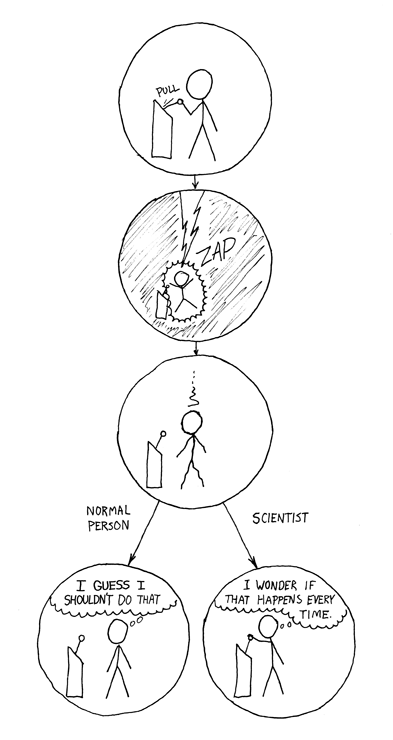 --xkcd, [The Difference](https://xkcd.com/242/) We should be moral scientists, not animals. ---- {:he} > טוב יפיק רצון מה׳; ואיש מזמות ירשיע׃ --משלי יב:ב {:.TODO} פוק is aramaic for "go out"; יפיק means "elicit, draw out". {:he} >וְתָפֵק לרעֵב נפשך ונפש נענה תשביע; וזרח בחשך אורך ואפלתך כצהרים׃ --ישעיהו נח:י {:.TODO} Doing good brings out favor from ה׳. Would expect the contrast to be "doing evil brings out ה׳'s punishment" but instead it is about the איש מזמות, "the man who plans". מזמה is one of those words that in תנ״ך are negative, planning sin: {:he} >ועשיתם לו כאשר זמם לעשות לאחיו; ובערת הרע מקרבך׃ --דברים יט:יט {:he} >ערות אשה ובתה לא תגלה; את בת בנה ואת בת בתה לא תקח לגלות ערותה שארה הנה זמה הוא׃ --ויקרא יח:יז {:he} > וכלי כליו רעים; הוא זמות יעץ לחבל עניים באמרי שקר ובדבר אביון משפט׃ --ישעיהו לב:ז {:he} ><em>זמה היא</em>: תרגם אונקלוס עֵצַת חִטְאִין היא וכתב רש"י שיצרך יועצך לחטוא. --רמב"ן, ויקרא יח:יז But it is often used positively in משלי: {:he} >לתת לפתאים ערמה; לנער דעת ומזמה׃ --משלי א:ד {:.TODO} we [defined it](/Middle+of+the+Road) as "mindfulness", The problem is being an איש מזמות, a person who is defined by their planning, thinking that everything can be reasoned out. {:he} ><em>טוב יפיק רצון מה' ואיש מזמות ירשיע</em>: מבואר אצלנו שפעל ”זמם“ מורה על מחשבות עמוקות שמעמיק במחשבתו איך להוציא איזה דבר, ואם בא בעניני החכמה, מורה על מחשבות עמוקות בעניני החכמה; ואם בא במחשבה שחושב נגד חברו הוא לרוב לרע, ואמר מחשב להרע ההוא בעל מזימות יקרא, כי אז מעמיק במחשבתו איך ירע לחברו ואיך ילכדנו במצודתו, ופעל ”מרשיע“ כשבא בהפעיל, אם הוא עומד, מורה שרשעתו גברה מאד עד שיוצא להרע לאחרים ברשעו... > אומר האיש הטוב לא יעמיק מזימות, רק יפיק רצון מה', ישתדל להוציא רצון מה' שירצה ה' את מעשהו, כענין (משלי טז:ג) גֹּל אֶל ה׳ מַעֲשֶׂיךָ וְיִכֹּנוּ מַחְשְׁבֹתֶיךָ, שאז יכונן ה' מחשבותיו הפשוטים על תכלית הנרצה אצל ה'...והוא לא יעמיק מזימות ולא ירשיע, ואיש מזמות הבלתי סומך על ה' רק מעמיק מזימות עמוקות יעשה מעשים להרשיע. --מלבי"ם, משלי יב:ב {:.TODO} can't be a complete נער, acting without thinking, but can't be an איש מזמות; need to סומך על ה׳. Otherwise will end up ירשיע, will do רשעות even if don't intend to. Human beings are not smart enough for pure consequentialism 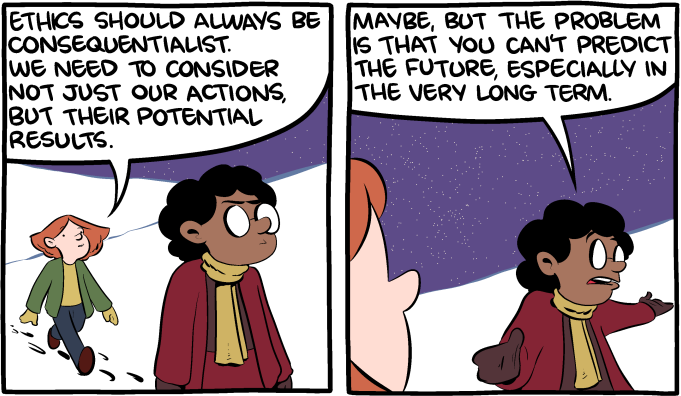 --SMBC, [_Consequentialism_](https://www.smbc-comics.com/comic/consequentialism) {:.TODO} And so Shlomo continues {:he} > לא יכון אדם ברשע; ושרש צדיקים בל ימוט׃ --משלי יב:ג {:he} >הרשעים אין להם שורש, כי שורש האדם הוא למעלה במקום טהרה, שהאדם דומה כעץ הפוך ששרשו למעלה והוא המוח שהוא שורש האדם והוא נטוע בעולם השכל שמשם מקבל שפעו, והצדיק דבוק בשרשו העליון, לא כן הרשע שנכרת משרשו העליון, והוא עומד הכן על עולם החומרי בגופו לבד, כדבר שעומד על בסיס בתלוש, אבל הכן הזה ג"כ עתיד להתמוטט --מלבי"ם, משלי יב:ג ---- {:he .lines} ><b>ד</b> אשת חיל עטרת בעלה; וכרקב בעצמותיו מבישה׃ <b>ה</b> מחשבות צדיקים משפט; תחבלות רשעים מרמה׃ --משלי פרק יב {:he} >אשה טובה שמשגת חן ע"י מעשיה הטובים, או לפי המליצה נפש יקרה טובה וחכמה שהיא האשה המליציית בספר הזה. --מלבי"ם, משלי יא:טז {:.TODO} אשה as your sense of self. אשת חיל עטרת בעלה is parallel to מחשבות צדיקים משפט; your inner mental processes need to be honest. 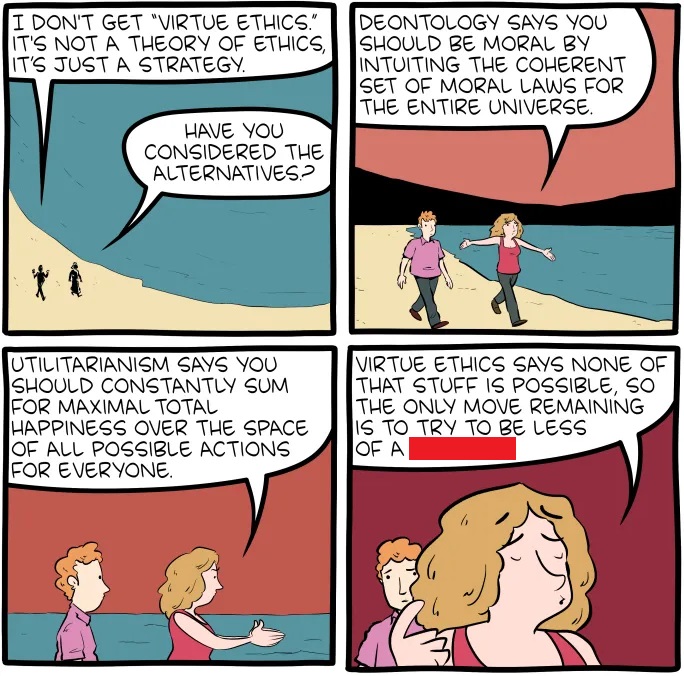 --detail from SMBC, [_Virtue_](https://www.smbc-comics.com/comic/virtue) {:he} >והצדיקים גם המחשבה הפשוטה שלהם הוא משפט שילכו בדרך המשפט והצדק ולא יטו ממנו, והרשעים גם התחבולות שהוא קישור עצתם הוא שיעשו רמיה לרמאות את רעיהם ולעשוק ולגזול, ולכן הצדיקים א"צ לתחבולות, כי די במחשבה שהוא לעשות משפט שזה הדרך הישר שא"צ להתחבל ולהתנכל, והרשעים אחר שצריכים להטות מן המשפט ולצוד את רעיהם במכמורת ע"י מרמה, צריכים לתחבולות וקישור עצות רעות רבות זה בזה, איך ילכדו את העשוקים במצודתם --מלבי"ם, משלי יב:ה 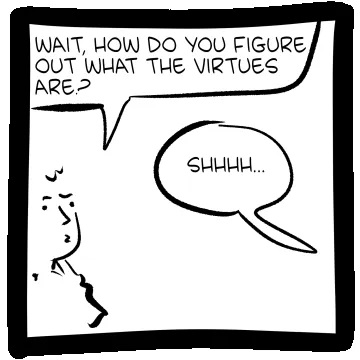 --SMBC, [_Virtue_](https://www.smbc-comics.com/comic/virtue), the after comic {:.TODO} which is of course the message of book one: (משלי א:ח) שמע בני מוסר אביך; ואל תטש תורת אמך. ---- {:he .lines} ><b>ו</b> דברי רשעים ארב דם; ופי ישרים יצילם׃ <b>ז</b> הפוך רשעים ואינם; ובית צדיקים יעמד׃ --משלי פרק יב {:.TODO} only by צדק and יושר can society survive; the society of רשעים is unstable. {:.TODO} דברי רשעים ארב דם is not because the רשע tries to destroy everything, but because in the absence of צדק the very fact that we want to serve our own interests--what we call the יצר הרע--leads to a race to the bottom. {:.lines} >What sphinx of cement and aluminum bashed open their skulls and ate up their brains and imagination? Moloch! Solitude! Filth! Ugliness! Ashcans and unobtainable dollars! Children screaming under the stairways! Boys sobbing in armies! Old men weeping in the parks! Moloch! Moloch! Nightmare of Moloch! Moloch the loveless! Mental Moloch! Moloch the heavy judger of men! Moloch the incomprehensible prison! Moloch the crossbone soulless jailhouse and Congress of sorrows! Moloch whose buildings are judgment! Moloch the vast stone of war! Moloch the stunned governments! --Allen Ginsberg, [_Howl_](https://www.poetryfoundation.org/poems/49303/howl), part II >What’s always impressed me about this poem is its conception of civilization as an individual entity. You can almost see him, with his fingers of armies and his skyscraper-window eyes... > Moloch is introduced as the answer to a question--C. S. Lewis’ question in <a href="http://www.moronail.net/img/1392_lil_jon_philosophy_what">Hierarchy Of Philosophers</a>--<i>what does it</i>? Earth could be fair, and all men glad and wise. Instead we have prisons, smokestacks, asylums. What sphinx of cement and aluminum breaks open their skulls and eats up their imagination?... > The implicit question is--if everyone hates the current system, who perpetuates it? And Ginsberg answers: “Moloch”. It’s powerful not because it’s correct--nobody literally thinks an ancient Carthaginian demon causes everything--but because thinking of the system as an agent throws into relief the degree to which the system <i>isn’t</i> an agent... > In some competition optimizing for X, the opportunity arises to throw some other value under the bus for improved X. Those who take it prosper. Those who don’t take it die out. Eventually, everyone’s relative status is about the same as before, but everyone’s absolute status is worse than before. The process continues until all other values that can be traded off have been--in other words, until human ingenuity cannot possibly figure out a way to make things any worse... > The question everyone has after reading Ginsberg is: what is Moloch? > My answer is: Moloch is exactly what the history books say he is. He is the god of child sacrifice, the fiery furnace into which you can toss your babies in exchange for victory in war. > He always and everywhere offers the same deal: throw what you love most into the flames, and I can grant you power. --Scott Alexander, [_Meditations On Moloch_](https://slatestarcodex.com/2014/07/30/meditations-on-moloch/) >The project of civilization [is] for man to graduate from the metaphorical savage, subject to the law of the jungle, to the civilized gardener who, while theoretically still subject to the law of the jungle, is so dominant as to limit the usefulness of that model. --Warg Franklin, quoted by Scott Alexander, [_Meditations On Moloch_](https://slatestarcodex.com/2014/07/30/meditations-on-moloch/) {:.TODO} Need to have values that override the יצר הרע. ---- {:he} > לפי שכלו יְהֻלַּל איש; ונעוה לב יהיה לבוז׃ --משלי יב:ח {:.TODO} in the worldview of Mishlei, this may be true, but why should the wise person care about what others think? I think that the answer is that we are all human, and we do care. Memetic desire means that the things that others praise become the things that we praise. Mishlei's advice here is that even if this pasuk is not literally true (people don't always admire wisdom), we should train ourselves to think that way, to pay attention when wisdom is lauded and perversion is scorned. There is a similar pasuk later on: {:he} >מצרף לכסף וכור לזהב; ואיש לפי מהללו׃ --משלי כז:כא That's usually translated as "[the worth of] a person is measured by how others praise them": {:he} >ומתחשב לפי מהללו ע"י שהבריות מהללות אותו במעשיו הטובים. --רש״י, שם But Rabbeinu Yonah reads it as "by what they praise": {:he} >ופסוק שלם יש לנו על זה ששלמה ע"ה אמרו ”מצרף לכסף וכור לזהב ואיש לפי מהללו“. כלומר לפי מה שהוא מהלל. --רבינו יונה,משנה אבות ד:ו >"A man can be judged according to his praise" doesn’t mean according to how he is praised but according to what he praises (“his praise”). What a person speaks highly about (and badly about) tells us a lot about his or her value system...Someone who is always seeing the bad in all things Jewish cannot be said to be honoring the Torah even if he is quite observant in his outward behavior. At a point, his criticisms tell us more about himself than about the person or institution he is maligning. --Rabbi Daniel Travis, [_Reflections of the Soul_](https://torah.org/learning/tefilah-reflectionsofthesoul/) That is שכל with regards to הלל. ---- {:he} > טוב נקלה ועבד לו ממתכבד וחסר לחם׃ --משלי יב:ט {:he} >כדאמר ליה רב לרב כהנא: נטוש נבילתא בשוקא ושקול אגרא, ולא תימא: גברא רבא אנא וזילא בי מילתא. --בבא בתרא קי,א {:he} >ובדרך המשל המתכבד ובוש מללמוד הוא חסר לחמה של תורה, והנקלה הוא עבד לעצמו היינו לנשמתו. --מלבי"ם, משלי יב:ט {:he} ><em>טוב נקלה ועבד לו</em>: טוב לאדם שיתבזה מעצמו ויהיה עבד לעצמו להמציא פרנסתו אף שהוא מלאכה בזויה. > <em>ממתכבד וחסר לחם</em>: ממי שיתנהג עצמו ברבנות ובכבוד ובעבור זה הוא חסר לחם. > וכן בתורה טוב להתבזות את עצמו ויהיה לעצמו עבד. כמו שכתוב (משלי ל:לב) אִם נָבַלְתָּ בְהִתְנַשֵּׂא [...יָד לְפֶה], ממתכבד את עצמו ומתבייש לשאול דבר ועושה עצמו שמבין ויודע הכל, ובעבור זה הוא חסר שלא ידע. --ביאור הגר״א, משלי יב:ט ---- {:he} > יודע צדיק נפש בהמתו; ורחמי רשעים אכזרי׃ --משלי פרק יב:י {:he} >כי תראה חמור שנאך רבץ תחת משאו וחדלת מעזב לו; עזב תעזב עמו׃ --שמות כג:ה {:he} >מטעמי מצוה זו: איסור צער בעלי חיים, שהוא איסור מן התורה... --ספר החינוך, מצוה תק"ו {:he} >--[נודע ביהודה מהדורא תנינא, שאלה י׳](https://www.hebrewbooks.org/pdfpager.aspx?req=1447&st=&pgnum=100) תשובה: שלום להאי צורב, העוסק בחקי חורב, ה״ה כבוד אהובי האלוף התורני מוהר״ר נומפריכט אפנהיים י׳׳ץ: > מכתבו קבלתי ואם אינני מכירו ולא ידענא ליה אך אשר בא לשאול שאילתא ומשתעי בלישנא דחכמתא מני משיב לכל שואל. ושורש שאלתו איש אחד אשר זכהו השם בנחלה רחבה ויש לו כפרים ויערות אשר בהיערות תרמוש כל חיתו יער אם אוסר לו לילך בעצמו לירות בקנה שריפה לצוד ציד או אם אסור לישראל לעשות דבר זה אי משוס צער בעלי חיים אי משום בל תשחית... > ואמנם אין לנו להאריך בזה...שכל דבר שיש בו צורך להאדם לית ביה משוס צער בעלי חיים וגם לא שייך צער בעלי חיים אלא לצערו ולהניחו בחיים אבל להמית בהמות וחיות וכל מיני בעלי חיים לית ביה משוס צער בעלי חיים...והנה עד כה דברנו מצד הדין. > ואמנם מאד אני תמה על גוף הדבר ולא מצינו איש ציד רק בנמרוד ובעשו ואין זה דרכי בני אברהם יצחק ויעקב...ואיך ימית איש ישראלי בידים בעלי חיים בלי שום צורך רק לגמור חמדת זמנו להתעסק בצידה... > ומי שהוא איש הצריך לזה ופרנסתו מצידה כזו בזה לא שייך אכזריות והרי שוחטין בהמות וחיות ועופות וממיתים דגים לצורך האדם ומה לי טהורים שיאכל מבשרם ומה לי טמאים שיאכל ויפרנס עצמו מדמי עורותיהן וכל בעלי חיים ניתנו לאדם לכל צרטו, אבל מי שאין זה לצורך פרנסתו ואין עיקר כוונתו כלל בשביל, פרנסתו הוא אכזריות. ועד כאן דברתי מצד יושר ההנהגה שראוי לאדם להרחיק מזה ועכשיו אני אומר אפילו איסורא איכא... {:he} >רבי...קבל עליה תליסר שני שית בצמירתא [רש״י: אבן שבמקום קטנים] ושבע בצפדינא [רש״י: חולי שבתוך הפה]... > על ידי מעשה באו. מאי היא? דההוא עגלא דהוו קא ממטו ליה לשחיטה. אזל תליא לרישיה בכנפיה דרבי וקא בכי. אמר ליה: זיל! לכך נוצרת. אמרי: הואיל ולא קא מרחם, ליתו עליה יסורין. > ועל ידי מעשה הלכו: יומא חד, הוה קא כנשא אמתיה דרבי ביתא. הוה שדיא בני כרכושתא וקא כנשא להו. אמר לה: שבקינהו! כתיב (תהילים קמה:ט) וְרַחֲמָיו עַל כׇּל מַעֲשָׂיו. אמרו הואיל ומרחם נרחם עליה. --בבא מציעא פה,א >There is a rule laid down by our Sages that it is directly prohibited in the Law to cause pain to an animal, and is based on the words: "Wherefore hast thou smitten thine ass?" etc. (Num. xxii. 32). But *the object of this rule is to make us perfect*; that we should not assume cruel habits: and that we should not uselessly cause pain to others: that, on the contrary, we should be prepared to show pity and mercy to all living creatures, *except when necessity demands the contrary*: “When thy soul longeth to eat flesh,” etc. (Deut. Xii. 20). We should not kill animals for the purpose of practising cruelty, or for the purpose of play. --Guide for the Perplexed, III:17, Friedlander translation >But R. Kook cautions against a looming moral hazard. When human morality progresses to a natural revulsion from eating animals, Vegetarianism will be universally appropriate. But in this unredeemed world, adopting this stringency is wrong and dangerous. It demonstrates a moral confusion, a failure to distinguish between people and animals. When people created in the divine image are suffering, R. Kook asks, how can we focus our energies on animal rights? It is “as if we have already corrected everything, already removed the reign of wickedness, falsehood, hatred and jealousy of nations, racism and tribal fighting that leads to so many deaths and the flowing of rivers of blood — as if all this disappeared from the land and there is nothing left with which this ‘human’ moralist to become righteous other than upholding ethics with animals”... > Vegetarianism risks erasing the distinction between man and beast. Animal rights are important but human rights moreso. Additionally, if animal rights are raised as a priority, some people will satisfy their instinct for generosity with animals while treating fellow people cruelly. We would find horrible humans who think they are righteous because of their kindness to animals. --Rabbi Gil Student, [_Is Vegetarianism Dangerous?_](http://torahmusings.com/2013/07/is-vegetarianism-dangerous) {:style=color:red} 🚧🏗️ Page Still Under Construction Home